
It surprises a lot of people that we can transform their dark grungy bells into shining treasures. The most common options for fixing up sleigh bells, starting with the most popular choice, include:
To polish or not to polish, that is the oft asked question! There is no one answer that is right for everyone. If you like your bells the way they are, then leave them unpolished. If your bells are black, crusty, and dirty, then get them spruced up so you can enjoy them.
In my opinion, it is completely acceptable to carefully restore sleigh bells to a typical "used" appearance. I occasionally get a lecture that old sleigh bells should never be cleaned and polished, because it "ruins their antique value".
Taking that advice at face value, then no antique metal item should ever be cleaned or polished.
That means Grandpa's Model A is more valuable rusting away in the back pasture than carefully restored to original working condition. And Grandma's sterling dinnerware should remain black with tarnish rather than gently polished to the handsome luster that so pleased her.
What do you think?
Our process for cleaning and polishing bells starts with soaking to loosen dirt and hardened oil followed by cleaning in a water-based detergent to remove the grime. We can stop after this cleaning step, if you prefer. The bells will be clean inside and out and have a soft brown color and gentle luster (see photos below).
Or we can continue on and polish your bells. Polishing will increase the shine and change the color from brownish to golden. Several coats of optional clear lacquer will prevent tarnish. The industrial lacquer we use is non-toxic when dry, is almost invisible, and does not affect the sound of the bells.
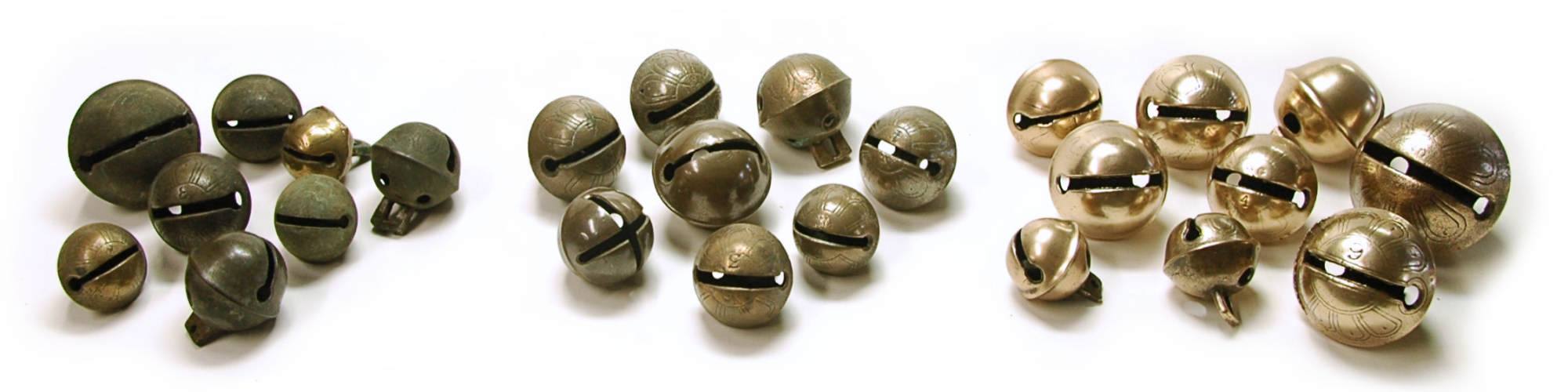
Examples of uncleaned, cleaned, and polished sleigh bells, all antiques from the late 1800s and early 1900s. Click on the image to see a larger version.
Left: Uncleaned bells. Two of the bells are unusually clean and would look nice if used as-is on a strap. The rest of the bells are more typical -- dark, rough, and dirty and not very appealing. The largest bell is so dirty that its "petal" pattern is covered over by the grime.
Middle: Cleaned bells showing a typical color variation from golden brown to grayish brown. These bells are clean inside and out, have a soft shine, and are smooth to the touch.
Right: Polished bells with a higher luster and golden color. The apparent brightness of the polish depends on the bell's surface texture -- more texture means the bell will look darker and more "antique-y".
Another question we often get asked is, "Can cracked sleigh bells can be repaired?" Technically, yes, some bells can be repaired, but it is not cost effective. A repaired bell will usually look nicer, but it may not be more durable nor will it necessarily sound better.
If you do want to repair a bell, find a jeweler or other expert who offers jewelry-grade "hard" soldering or laser- or micro-welding and expect to pay $30 to $100 per bell. I cannot recommend conventional brazing or "soft" (tin-lead) soldering -- these methods just do not work well in this situation, where a delicate yet strong bond is required.
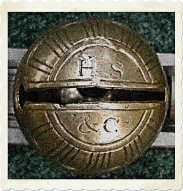
Photo: A bell worth repairing. Our local jeweler laser welded a serious crack in this rare bell. The crack ran along the upper half of the center circle, through the right side of the letter "H", and down to the center of the throat (slit.)
Sleigh bells made of steel were first made in the mid 1900s. Steel bells are an inexpensive alternative to solid-brass bells, costing well under $1 each in new condition. If your bells have a rough, reddish coating on them, they may be steel, rather than solid brass. Do a quick check -- if a magnet "sticks" to the metal, the bells are steel. If the magnet does not stick, the bells are probably brass.
We certainly can restore your older steel bells and put them on a new strap, but it is not cost effective to do so. We do not recommend restoring steel bells, unless they have a lot of sentimental value. Steel bells do not clean up as nicely as brass bells do. Cleaned and polished steel bells will range from soft silvery grey to a pitted deep brown, depending on how much they were rusted to begin with. The sound may not improve after cleaning and polishing, especially if the bells were very rusty to begin with. View examples of restored steel bells...
The classic type of sleigh bell -- the "shank" bell -- is traditionally fastened onto a strap with a figure-8 bell pin. Shank bells are fairly easy to remove from a bell strap and to replace using a fresh pin. A second type of sleigh bell -- the "rivet" bell -- was invented in the late 1800s and was produced through the early 1900s. These bells are more difficult to remove from their original strap and to prep for reuse on a new strap.
Although we have years of experience working with rivet bells, we occasionally break a few when we remove the rivets. Experience has shown that bells with cracks, very rusty rivets, or a structurally weak design are the most likely to break. We want our clients to be informed about this risk. We do not offer any guarantees against breakage, other than our promise that we will take reasonable care to avoid unnecessary damage.
Most rivet bells were originally fastened onto their strap with a copper or steel rivet. Some rivet bells produced in the late 1800s by William E. Barton were fastened with a small screw. We have experimented with using rivets, and the results have been unsatisfactory and unreliable. Instead, we use machine screws to attach rivet-style bells to straps. They do look different than rivets, so we want our clients to be fully aware of this issue.
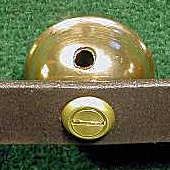
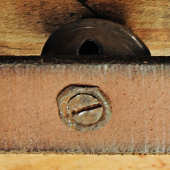
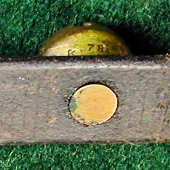
Left: Bell with its original copper rivet fastener. A steel or copper rivet is the most common type of original fastener for this type of bell.
Middle: Bell with its original steel screw and washer. This fastening system was patented by William E. Barton in 1865.
Right: Bell with our choice of replacement fastener -- solid brass screw and washer.
Many folks want to know more about the age and origins of their bells. Please see: Sleigh Bell Designs: What different kinds of sleigh bells are there?
Copyright © 2002-2025 - All rights reserved by Classic Bells Ltd.
Template by OS-templates.com
