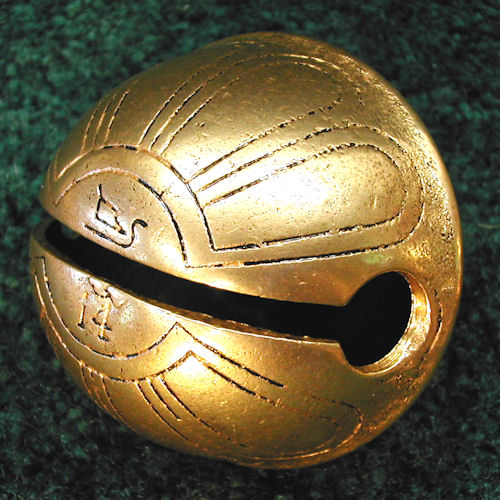
If you plan to quote material from this website, please read our copyright reminder...
Captain William Barton II (1740-1793)
Possibly W B maker's mark on petal bells.
Captain William Barton started to make sleigh bells and pistols about 1778. He lived in Wintonbury (now Bloomfield) (6) or Farmington, Connecticut (19). Captain Barton was married in 1761 to Sarah Sage (b 1745). (3) Their children were William, Joseph, Sarah, and Hanna. (19)
William Barton III (1762-1849)
W B or B W maker's mark on petal bells.
William Barton was listed as an "artificer" in an early census. (3) He may possibly have been making sleigh bells as early as the 1790s in New York state. (6) By 1808, he had built a foundry in East Hampton, Connecticut, to produce hand and sleigh bells. (9) These bells were smoothed by hand on a lathe. In 1816, the original foundry was destroyed by fire, and a new foundry was constructed. More about bell making in East Hampton....
In 1826, Barton moved his foundry to Cairo, New York, and resumed operations with two of his sons William IV and Jason. Barton applied for a pension in 1833 and presumably retired at that time. (19)
William Bevin who later became a noted bell maker got his start as an indentured servant at Barton's Cairo foundry. More about Bevin....
William and his wife Clarissa Betts (b about 1767, d 1851 or 1858) had eleven children, although two died young. (3) Their children included Nancy, William IV, Clarissa, Hubbard, Hiram, Almira, Julia, Philura, and Jason (9) and Robert who died in infancy and Barzillia (19). As adults, all of his surviving sons made bells of various kinds.
Some sources credit Barton with making the first one-piece cast sleigh bell about 1809 (1, 9), but this is just an interesting fable. One-piece crotals were made in the UK as early as the 1500s. (8) One source also suggests that some bells with the W B maker's mark may have been made by his father Captain Barton. (6)
Having seen many WB bells, I do know the design of WB bells varied greatly over time. The earliest bells with the "WB" maker's mark look similar to elegant British "rumblers" made in the late 1700s and very early 1800s. This was the era in which when Barton's father and Barton himself would have been making sleigh bells, so it is likely that both men were influenced by British designs. (5) Later WB bells, while still attractive, are not as ornately detailed. Except for the WB mark, these bells are indistinguishable from ones made by Barton's sons Hiram and/or Hubbard (see below). (5)
I cannot confirm whether this variation was due to two men, father and son, who both made sleigh bells. It may also have been that William Barton III was willing to experiment and innovate, and the design of his bells evolved over time.
Hubbard Barton (1797-1860)
Possibly the W B and/or H B maker's mark on petal bells.
Hubbard, one of William Barton's sons, took over the bell business started by his father in East Hampton. He may possibly have made bells with the W B mark, even after his father retired, since William Barton's master mold patterns would have lasted for many years with good care.
Hubbard married Deborah G. Clark in 1821, and they had 12 children. (9)
Hiram Barton (1799-1878)
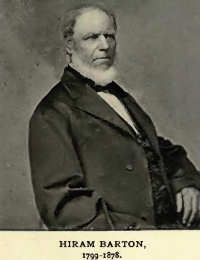
Possibly the H B maker's mark on petal bells.
Hiram began his own bell business in East Hampton. Hiram's son William E. worked in and later owned the business, which was eventually reorganized in 1881 as the Barton Bell Company.
In 1825, Hiram married Lois L. Watrous, b about 1806, d 1882 (11) or 1887 (13). They had 4 children; William E. was the eldest, and John W. was another son (see below). (9)
Jason Barton (b about 1808, d 1862)
Probably no maker's mark.
Jason was a younger brother of Hubbard and Hiram. He manufactured bells for a time in Middle Haddam, Connecticut, in partnership with A.B. Bailey and George S. Hubbard. Their firm, not surprisingly, was named Barton, Bailey & Hubbard. (9) Jason patented designs for a call bell and a door bell. After his own company folded, Jason worked for his nephew, William E. Barton, and continued to manufacture his call bells. (9) Jason is credited with developing a way to polish bells by tumbling them in barrels of sand (9). This was a money- and labor-saving alternative to the original process of smoothing each bell on a lathe. (5)
John Watrous Barton (b about 1835, d 1867)
Probably no maker's mark.
John was the son of Hiram Barton and the grandson of William Barton. He worked with his father and brother in their family foundry. He later formed a partnership with Alfred B. White to manufacture a call bell patented by his uncle Jason. (9) Poor health forced him to quit the foundry business and become a part owner in a grocery. He worked in the grocery until his early death. (9)
William E. Barton (b 1826 or 1830?, d 1895)
W E B and a running horse logo on petal bells.
No maker's mark on his other styles of bells.William E. (Edward?) Barton was the son of Hiram Barton and grandson of William Barton. Barton manufactured sleigh bells at his father's East Hampton foundry until it was destroyed by fire in 1874. William E. relocated the business to a nearby foundry originally built by the Union Bell Company and resumed making bells. By 1881, the business had been sold to new owners and renamed the Barton Bell Company. (9)
William E. patented several innovative designs for sleigh bells and bell straps in the mid 1800s. One of his patents from the 1860s describes the way he drilled and tapped the base of bells so they could be fastened to a strap with machine screws, rather than the more common rivets. Another patent covers a unique method for attaching buckles to bell straps. (5)
From the bells I have seen, William E. made petal, round ridge, globe, band, stamped egg, and "Eastlake" style bells mostly in the 1 1/4" to 1 3/8" size range. Many of these bells were plated with soft nickel or tin. Although only his petal bells had his initials and running horse maker's mark, all of his bells can be identified by his patented machine screw fasteners.
Many of his globe and round-ridge bells show another innovation -- they have a separate oval-shaped metal collar between the bell and its strap. According to his patent, the collar raises the bell off the leather to improve the sound. (5) In my restoration work, I have seen collars made of plated steel, copper, and lead. The separate oval collar was eventually incorporated into the design of his bells, so the bell and collar were cast in one piece.
Barton's stamped egg bells are also unique because they have a separate cast-brass base crimped into the bottom of the bell. This base greatly improves the sturdiness of these otherwise delicate bells.
William E. made cast-brass petal bells larger than 1 3/8", although they are not as common as his smaller bells. These larger bells are marked with his running horse logo, but some have a cast shank and others have his patented machine screw fastening.
Although the machine screw fastener works well for the smaller bells, it is not nearly as good for larger, heavier bells. A traditional cast shank is a better design.
William E. was married to Harriet Watrous in 1853. (12) His son Abner Watrous Barton was part owner of the Barton Bell Co.
Barton Bell Company
No maker's mark.
In 1881, the foundry originally owned by Hiram Barton and later his son William E. Barton was sold and reorganized as the Barton Bell Company. The principals in this new company were Abner Watrous Barton, president; Adeline G. Barton (AW's wife), secretary/treasurer; and Orlando Launcelot Clark, investor. Along with other products, the Barton Bell Co. continued to make sleigh bells designed and patented by William E. Barton, including a saddle gong and a globe-style sleigh bell. (9)
The company employed about 50 people, including Albert W Sexton, shop foreman and secretary, and Joseph Deming Barton, laborer. The company was originally located in East Hampton, Connecticut, but moved in 1888 to Marion, Indiana (Grant county). (21) The company closed its doors in 1892. (19)
Vine B. Starr
V.B. Starr was printed in full along the base of each petal bell and/or V B mark on top of the bell.
Vine B. Starr operated his own foundry in East Hampton, Connecticut. (5) Vine B. may also be the Lieutenant Vine Starr who married Nancy Barton (born 1790), daughter of the elder William Barton, in 1813. (3)
Barton & Starr Manufacturing Co.
Barton & Starr was printed in full along the base of each petal bell.
Vine B. Starr and a member of the Barton clan, possibly Jason Barton, operated another foundry in partnership. This foundry was also in East Hampton, Connecticut. (6)
Barton & Clark
Probably no maker's mark.
The business was owned by William E. Barton and Orlando Clark. (2)
Starr Brothers Bell Company
No known maker's mark.
The Starr Brothers Bell Company was established 1882 by brothers George M., J. M., Wilbur F., and Vine B. Starr. (2) In 1915, the business published its Catalog #63 with a full line of sleigh bells and other related items. The business went bankrupt in the mid 1950s. (14)
William Bevin
The center of each petal bell is surrounded by a ring of the words "W Bevin" and "E Hampton" in block letters.
"...William Bevin [and his brother Abner] learned the art of bell making while working as an indentured servant to William Barton ... [in the late 1820s or very early 1830s at Barton's foundry] in Cairo, New York.
"Bevin agreed to the terms and tenure of the indenture under the condition that he could use the craft where and when he desired after he left...." (20) Words in brackets [ ] are the editor's
During a phone conversation with descendent Matt Bevin, I got the distinct impression that the Bevin boys' service to William Barton was unusually difficult, and they left service with no great love for Barton. William returned to his home town of East Hampton and began his career in metal casting.
Bevin Brothers -- William Bevin, Chauncey Bevin, Abner G. Bevin, and Philo Bevin
Maker's mark unknown.
In 1830, a metal-casting business in East Hampton, CT, was started by Butler N. Strong, Harry Strong, Dan. B. Niles, and Alfred Williams. In 1832 (20) or 1837 (9), William Bevin along with brothers Chauncey and Abner bought this foundry (9) and started their own business as the Bevin Brothers. In 1838, a fourth brother Philo also entered the business. (9, 20)
According to an 1884 history of the East Hampton, the company manufactured sleigh, hand, house, cow, sheep, door, and ship bells, preserve kettles, and waffle irons. (9)
The Bevin company website adds, "...The brothers made sleigh, hand, house, cow, sheep, door and ship’s bells. They also made up to twenty different sizes of common sleigh bells of the globe, band, or rim variety. Bevin Brothers was reported to produce the first bicycle bells ever made. The first foot bell ever used in an automobile was also produced by Bevin and was patented in 1897...." (20)
In 1868, the business was renamed Bevin Brothers Manufacturing Company. (9)
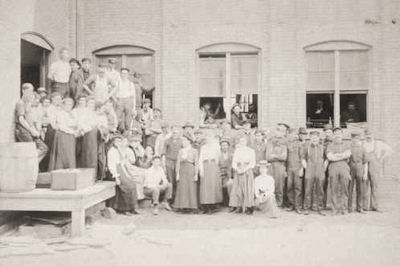
Photo above: Workers at the Bevin Bros. Mfg. Co., ca 1910. Connecticut Historical Society and Connecticut History Online.
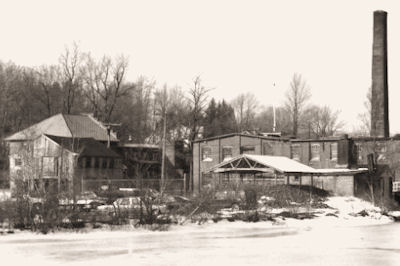
Photo below: Bevin Bros. Mfg. Co. facilities before the 2012 fire. The original 1830 factory building is on the left. National Register of Historic Places and the Connecticut Historical Commission.
Bevin Brothers Manufacturing Company
No maker's mark.
The four Bevin brothers William, Chauncey, Abner, and Philo finalized the name of Bevin Brothers Manufacturing Company in 1868 (see previous entry). (9)
The company, now owned by direct descendant Matthew G. Bevin, is still in business today, despite a destructive fire caused by lightning in May, 2012. Bevin produces only a small fraction of the products it made in the late 1800s.
J. N. Goff and Amiel Abel
G & A maker's mark on petal bells.
J. N. Goff, Amiel Abel, and Alfred Williams
G. A. & W. maker's mark on petal bells. 1837-1851.
J. N. Goff, Amiel Abel, and Charles Buell
Mark unknown.
Philo S. Parsons & Clark N. Smith
The center of each petal bell is ringed with "Parsons &" on one half of the bell and "Smith.E.H.Ct" on the other half. "E.H.Ct." stands for East Hampton, Connecticut.
The business was owned by Philo Skidmore? Parsons, b. Nov 13, 1813?, and Clark Norton Smith, b Dec 25, 1819. (16) In addition to being a bell maker, Philo accepted a contract in 1857 to deliver mail 3 times a week on a route from Middleton to Marlboro, Connecticut. (17)
East Hampton Bell Company
Probably no maker's mark.
Formed by J. N. Goff, Amiel Abell, J. S. Hall, D. W. Watrous, and G. S. Goff, possibly in 1851.
Hiram Veazey and A.B. White
Probably no maker's mark.
The Veazey & White Bell Company operated from 1842 to 1882 when it was bought by the Starr Brothers Bell Company (see above.)
Warren Veazey
Probably no maker's mark.
Hiram Veazey
Probably no maker's mark.
Hiram was awarded a patent in 1869 for a "round ridge" style of bell that had a cylindrical "pillar" about 3/16" tall as its base. The pillar raised the bell off the leather strap for better sound.
Another distinctive feature of his bells is the teardrop-shaped clean-out holes around the base of the bell. The clean-out holes on other makers' bells are circular.
Warren Veazey may have been his brother. See also Russell & Erwin (below) for another maker of similar round ridge bells.
Hiram and Warren Veazey
The center of each petal bell is ringed with "H. &" on one half of the bell and "W. V." on the other half. On the lower side of the bell is the marking "E. H. Ct." an abbreviation for East Hampton, Connecticut.
Charles Buel and Hiram Veazey
Founded 1842?
Niles and Strong Co.
Mark unknown. Founded 1840?
William H. Belden and Isaac N. Lee
B & L maker's mark on larger petal bells.
Smaller bells are unmarked, but otherwise have the same design details as the larger bells.This New Britain, Connecticut, foundry operated from the early 1830s through 1841, when the foundry was destroyed by fire. (6) Bells have a drilled shank.
James North, Jr.
J N or I N maker's mark on petal bells.
James (born 1777, died 1825) made bells in his New Britain foundry from 1800 to 1803 after he and Joseph Shipman completed a metal-casting apprenticeship in Stockbridge, Massachusetts. Both men worked together in 1800 casting sleigh bells, then went their separate ways. (18) James then operated the North foundry with his younger brother Seth (below) until James moved to New York state in 1803. (6, 18) Bells marked with I N are thought to be older than the J N bells. Bells have either a drilled shank or a U-shaped cast shank.
Seth J. North
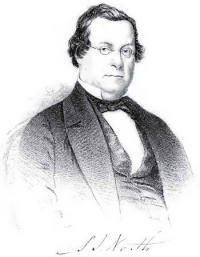
S N or N S maker's mark on petal bells.
Seth North, born 1779, died 1851, was the younger brother of James North. Seth originally worked with his father as a blacksmith, but about 1801 he started to cast sleigh bells with his brother James after James and Joseph Shipman (below) ended their brief partnership. Seth took over full operation of the North foundry in 1803 after James moved to New York state. (18) Seth's early bells have a U-shaped cast shank. His later bells have the drilled shank that characterizes most New Britain sleigh bells.
Seth was active in a variety of business pursuits in New Britain throughout his lifetime. His bell foundry closed in 1840. (6)
"...For many years these shops of North and Shipman were the principal manufactories of brass goods in their line in the country, and their products were sent to Boston, New York, Philadelphia, and other cities...." (18)
Seth North and Henry Stanley
N & S maker's mark on some larger petal bells.
Some have a 5-pointed star in place of or in addition to the N & S.
All bells have a distinctive sunburst design in each petal.This New Britain, Connecticut, foundry operated from about 1832 to 1850 when it was sold to Russel & Erwin (below.) (6)
Seth North, Henry Stanley, and William Smith
Maker's mark unknown. Founded 1830s?
Joseph Shipman
I S or J S maker's mark on petal bells.
Some with the J S mark also have an asterisk (*) in each petal.Joseph Shipman, born 1779, died 1859. (7) He started to make sleigh bells after James North, Jr., and he completed a metal-casting apprenticeship in Stockbridge, Massachusetts. In the spring of 1800, both men worked together making sleigh bells, then in 1801 they formed separate foundries in New Britain, Connecticut. (18) Shipman's foundry operated from about 1801 to ?. (6) Bells marked with an I S are thought to be older than J S bells.
Joseph Shipman and James North
Maker's mark unknown.
Shipman and North worked together in 1800 casting sleigh bells, after they had completed a metal-casting apprenticeship in Stockbridge, Massachusetts. In the spring of 1800, both men worked together making sleigh bells, then in 1801 they formed separate foundries in New Britain, Connecticut. (18)
Russel & Erwin Manufacturing Company
Plain "round ridge" bells with no daisy pattern and no maker's mark. Size markings (4, 5, 6, etc.) may be on the base of larger bells.
This company had a variety of names, depending on its owners, and made a wide variety of products, including screws, nails, metal handles, decorative items, builders hardware, as well as sleigh bells.
It originally started as the Stanley, Woodruff, & Co. (1835-1839), then the Stanley, Russell, & Co. (1839-1841), the Matteson, Russell, & Co. (1841-1845), and finally the Russel & Erwin Company (1846-1850).
It was finally reorganized and renamed in 1851 to the Russell & Erwin Manufacturing Company. In this final incarnation, the company operated in New Britain through at least 1878. (6, 18)
Russel & Erwin made many, but not all, bells in the "round ridge" style. See also Hiram Veazey (above) for another maker of round ridge bells.
Joseph Barton
Maker's mark unknown.
Joseph Barton produced and sold sleigh bells in the 1790s in Stockbridge, Massachusetts. Joseph's connection, if any, with the William Barton family is unclear. Joseph is credited with training apprentices, in particular James North and Joseph Shipman, who later established bell foundries in New Britain, Connecticut. (6)
Orson Starr and son John Almon Starr
Maker's mark unknown.
Orson Starr (1803-1873) and his wife Rhoda Gibbs (1806-1853) immigrated in 1831 to Royal Oak, Michigan, from Richmond, New York. Orson started a foundry that same year -- the area's first industry -- to manufacture bells for cows, sheep, horses and other animals. (4) Orson was possibly the second son to Lieutenant Vine Starr (see Barton & Starr Manufacturing Co., above.) His son John Almon (1846-1895) took over operation of his father's Michigan foundry and made animal bells until the foundry was closed in 1866. John was married to Nancy Quick (1831-1895.) (4)
C. Phelps and R. Atskill
The initials "C R" in the center of petal bells. The initials are surrounded by a ring made by the last names of "Phelps" and "Atskill".
Foundry location and dates of operation are unknown.
William "Bill" R. Schall (modern era)
Many of his larger bells are marked with a distinctive sleigh maker's mark (see photo). The mark was adapted from the letters of his initials BRS.
Bill Schall (b 1942, d 2010) of Pennsylvania produced a line of high-quality sleigh bells from the 1970s through the 2000s. He patented his method of casting sleigh bells in 1982. His bells look identical to cast sleigh bells from the late 1800s; this is a unique accomplishment for a modern producer.
Major George W. Tucker and possibly the American Ring Company
The oldest Tucker bells are marked with the single patent date of "PAT. OCT 24. [18]76" circling the base of each bell.
The base of the most common style of "patent" or "Tucker" bell is circled with two patent dates of "PAT. OCT 24. [18]76 & MAY 14. [18]78". A maker's mark of a diamond with a small dot in the center may also be present. Later Tucker bells are completely plain, but are otherwise identical in shape and design details to earlier versions. See photos of these bells...
These bells are found in single throat (slit), double throat, and triple throat versions, with many minor variations in size, shape and design. Nearly all Tucker bells are machine stamped from yellow brass sheet, although small numbers of the triple throat version were also stamped from sheet steel. The bells were probably produced by the American Ring Company of Waterbury, Connecticut, that was organized in October 1852.
"[The American Ring Co. produced] saddle, harness and carriage hardware, patent brass, silvered and iron rings, etc. Their factory, until destroyed by fire, January 5, 1872, was on Canal street [in Waterbury]. The Ring Co. is now [1894] under the control of the Plume & Atwood Manufacturing Co...." (15)
Tucker's two patents describe the manufacture of a double-throat bell stamped from thick sheet bass. Tucker was awarded 21 design patents between 1869 and 1882, including the two for his sleigh bells. (15) Tucker, a prominent, respected citizen of Waterbury and an officer of the American Ring Company, was dismissed in disgrace from the company in 1886 after being accused of embezzling a substantial sum of money. (10)
Tucker was married to Susan A. Northrop. (15)
References
(1) Terry Keegan, Douglas Hughes, Claude A. Brock, Ran Hawthorne. Horse Bells. National Horse Brass Society, Surrey, England. 2nd ed. 1988.
(2) Israel Foote Loomis, "The Town of Chatham", The Connecticut Magazine; 5:6, June 1899, pp 303-319; and 5:8?, August 1899, pp 370-381. Source: http://freepages.genealogy.rootsweb.com/~jdevlin/town_hist/chatham_ct_hist.htm
(3) Gary Barton. The Barton Database. Source: http://www.bartondatabase.info/
(4) Jim Brennan. Michigan Historical Markers Source: http://www.michmarkers.com/
(5) DeeAnna Weed. Personal research notes.
(6) Gary W. Spickler. Sleigh Bells of New Britain, Connecticut. The Bell Tower. 63:6, Nov.-Dec. 2005, pp 22-25. American Bell Association International, Inc.
(7) James Stanley, editor. Fairview Cemetery: A Chronicle of Eminent People in Fairview Cemetery, New Britain, Connecticut. May 14, 1999. Source: http://www.rootsweb.com/~cthartfo/fairviewcem.html
(8) Rod Blunt. Crotal Bells. UK Detector Finds Database. 2005. Source: http://www.ukdfd.co.uk/pages/crotal-bells.html
(9) Chatham: The early settlers and their descendants, part 1. The History of Middlesex County 1635-1885. J. H. Beers & Co., 36 Vesey Street, New York. 1884. Pages 198-217. Source: http://freepages.genealogy.rootsweb.com/~jdevlin/bios/chatham_bios.htm
(10) "Waterbury's sensation: Serious charges against a prominent citizen." The New York Times, February 12, 1886. Source: http://query.nytimes.com/mem/archive-free/pdf?res=9F02EEDB1E3EEF33A25751C1A9649C94679FD7CF
(11) Lakeview Cemetery East Hampton, CT. Copied by E.E. Freeman, and James J. Macintosh on 8 Nov 1934. Transcribed by David Wylie. Source: http://dunhamwilcox.net/ct/chatham_lakeview_cem.htm
(12) Chatham, Middlesex Co., CT, Vital Records from Barbour, T to Y. Transcribed by Coralynn Brown. Source: http://dunhamwilcox.net/barbour/chatham_barbour_t-y.htm
(13) Baptisms, marriages, deaths, and membership of the Congregational Church, East Hampton (Chatham), Connecticut. 1900. Source: http://www.archive.org/stream/earlyrecordsofba00east/earlyrecordsofba00east_djvu.txt
(14) 218 F2d 641. In the Matter of Starr Brothers Bell Company, bankrupt. No. 62, Docket 23159. Source: http://openjurist.org/218/f2d/641/in-the-matter-of-starr-brothers-bell-company
(15) The town and city of Waterbury, Connecticut..., Vol. 2 and 3 of 5 total. Joseph Anderson, Sarah Johnson Prichard, Anna Lydia Ward, editors. The Price & Lee Co., New Haven CT. 1895. Sources: http://www.archive.org/details/towncityofwaterb02ander and http://www.archive.org/details/towncityofwaterb03ande
(16) Dwight, Benjamin W. The history of the descendants of Elder John Strong, of Northampton, Mass. J Munsell, Albany, NY. 1871.
(17) Executive documents printed by order of the House of Representatives during the first session of the thirty-fifth Congress, 1857-58. James P Steedman, Washington, DC. 1858. pg 136
(18) Trumbull, J. Hammond, editor. The memorial history of Hartford County, Connecticut. 1633-1884. Volume 2: Town Histories. Edward L. Osgood Publisher, Boston. 1886. pg 296-297, 314. Source: http://www.archive.org/details/memorialhistoryo02trum
(19) Bell, Jeffrey S. Personal communication dated 9/5/2012. Email address jbell42@deccacable.com.
(20) Bevin Brothers Manufacturing Company. http://www.bevinbells.com/about.asp
(21) Directory of Indiana Manufacturers and Buyers' Guide. American Implement Publishing Company, Indianapolis IN, 1889. Viewed 1/2026: https://genealogytrails.com/ind/grant/directory1889.html
Copyright © 2002-2025 - All rights reserved by Classic Bells Ltd.
Template by OS-templates.com