
If you plan to quote material from this website, please read our copyright reminder...
The "petal" or "horse shoe" bell is the classic cast-brass horse bell. U.S. manufacturers called them "rim" or "round" bells in the late 1800s, but these names are no longer in current use. They are known in Britain as "rumbler" bells.
The petal bell has been made by American and British craftsmen for at least 400 years (1) and is found on all types of bell straps. In North America, petal bells vary in size from a tiny 3/4 inch in diameter to a massive 4 inches. Some British rumblers are even larger.
The petal bell is easily distinguished from all other horse bells by its ring of daisy-like petals or horseshoes circling the top, divided evenly by a single throat (slit) that has rounded ends. A typical bell has a total of 4 to 8 petals, although some older bells have as many as 12. The number of petals depends on the size of the bell and the maker's whim.
Every petal bell also has some type of ridge running around its middle and two or four holes cast into the lower half of the bell. Most petal bells have a shank base and were attached to a strap with a separate metal bell pin. Some petal bells made after about 1860 did not have a shank. Instead, these bells have a hole drilled through the bottom. They were attached to their strap with rivets or machine screws. More about shank- and rivet-style bells...
All bells shown below were made in the late 1800s or early 1900s unless otherwise noted.
The classic style of petal bells has a double line bordering each petal. This doubled line looks a bit like a horse shoe, so some people call these "horse shoe bells." The number of petals per bell and the spacing between petals varies from maker to maker. The petals may be close enough to touch each or they may be separate.
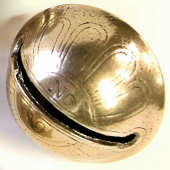
Left: Bell with 6 petals separated by wide gaps. 1 3/4 inch diameter. The center is marked with the size "6".
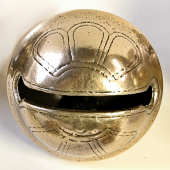
Middle: 2 inch diameter bell with 6 petals that touch. The center is marked with the size "8".
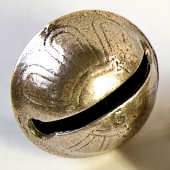
Right: Bell with 8 petals separated by a small gap. The center is marked with "No" (number) and the size "10". 2 1/4 inch diameter.
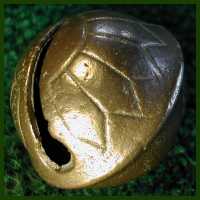
Even though the doubled petal style is very common, it is not the only style made. Some variations have petals outlined with a single line, like a flower petal drawn by a child. Sometimes a small dot, slash, star, diamond, or oval decorates the center of each petal.
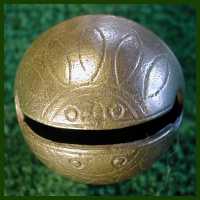
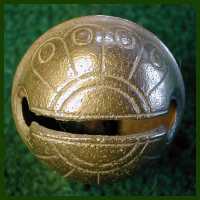
Left: Bell with a total of ten dagger-shaped petals. 1 1/4
inch diameter.
Middle: Bell with "O" shapes in the petals. 1 1/4 inch
diameter.
Right: Bell with sharply pointed daisy-like petals. A nearly illegible letter "B" is
lying sideways between the upper pair of small circles.
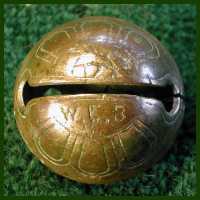
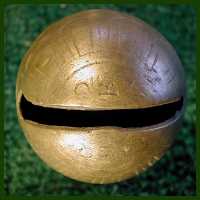
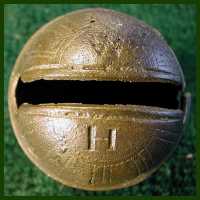
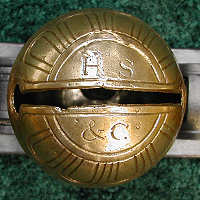
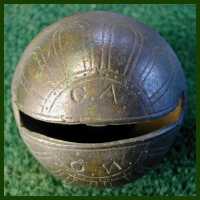
The center of the "daisy" is usually defined by one or two center circles. There may be tiny dots or dashes ornamenting the two circles. The center is blank on many bells. Other bells are marked with a number indicating the size of the bell. Sometimes the size number is accompanied by the abbreviation "No." (for "Number".) In a few cases, the center may contain a maker's mark -- a symbol, initials, or words indicating who made the bell.
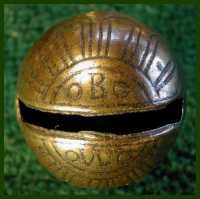
Left: Bell made by William Barton with eight petals
that do not touch. Bell is marked with "B" and "W". 1 3/8 inch diameter. Early 1800s.
Middle: Bell made by William's son Hubbard or Hiram Barton. Marked
with "H" and "B". 1 3/8 inch diameter. Early 1800s.
Right: Bell made by grandson William E. Barton with six petals that touch. Marked with a running horse logo and "W.E.B". 1 3/8 inch diameter.
Left: Bell with maker's mark "G. A. & W." made by Goff, Abell & Williams. 8 separated petals. 2 inch diameter. Early 1800s.
Middle: Bell with maker's mark "H. S. & Co ." 8 separated petals. Maker name is unknown. Early 1800s.
Right: Well-used bell with "W H" maker's mark and 8 petals that touch. 1 3/4 inch diameter. Maker unknown -- possibly Warren and Hiram Veazey? Early 1800s.
References
(1) Terry Keegan, Douglas Hughes, Claude A. Brock, Ran Hawthorne. Horse Bells. National Horse Brass Society, Surrey, England. 2nd ed. 1988
Copyright © 2002-2025 - All rights reserved by Classic Bells Ltd.
Template by OS-templates.com
