
Ornaments, including bells of all kinds, have been used to adorn horses worldwide from at least 800 BCE through today. Horse bells attracted good luck; protected against disease, injury and evil; flaunted the owner's wealth and status; and enhanced the horse's natural beauty.
Horse bells have always had a practical purpose as well as a decorative one. They warned pedestrians and other drivers to the approach of oncoming vehicles and alerted potential customers that street vendors and delivery wagons were in the neighborhood.
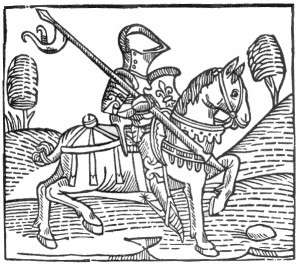
Drawing: Knight and horse with bells on its harness
In Britain, a few horse bells dating to Roman times have been found. The book Game and Playe of Chesse by William Caxton, published about 1474, shows a knight riding a horse with a single crotal mounted on its rump. In the 1500s and 1600s, horse bells were were often plated with gold or silver, engraved with coats of arms and inscriptions, and presented as gifts and awards. (5) In the 1700s and 1800s, horse bells in Britain were often used on pack horses traveling narrow trails through the mountains and hills. These bells were also used in the 1800s and 1900s on horses pulling wagons along winding country lanes in southern England and Wales.
The British bell-makers best known to North Americans are probably Robert Wells I and his sons Robert II and James. From about 1760 to about 1826, the Wells cast hand bells, church bells, clock and room bells. They were most famous, however, for the "rumblers" they cast with a distinctive RW maker's mark and ornate petal design (right.)
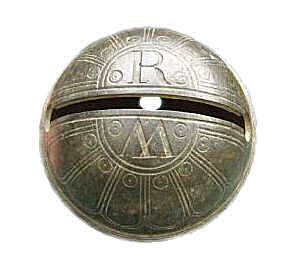
Photo: Massive 5 1/2" diameter crotal from the Robert Wells foundry
The bell foundry made famous by the Wells was in Aldbourne, Wiltshire, England. It had originally been established in 1693 by Robert Cor, who operated it from 1693 through 1741. It was then owned by John Stores from 1741-1744 and by Edward Read from 1744-1760. Like the Wells, the owners Cor, Stores and Read also produced a variety of bells, but they were best known for their church bells. (5)
North American makers were manufacturing horse bells as early as the 1700s, but U.S. production rates were modest until the mid-1800s. (1)
In the 1800s, horse bells were used for wintertime recreation as well as for work. Winter pleasure drives required fashionably warm clothes, handsome sleighs, well groomed horses, and nicely polished harness and bells. This strong association of horse bells with Christmas and winter fun led people to gradually call them "sleigh bells" instead.
Sleigh bells became a part of popular culture, leading to songs, stories, and poetry about them. The most popular example is the song "One Horse Open Sleigh", known today as "Jingle Bells". It was written by James Lord Pierpont in 1857. Another example, not as well known, is the poem "Sleigh Bell" written by Yakov Polonsky in 1854.
The U.S. sleigh bell industry began to grow strongly in the early 1800s. William Barton is credited with starting the sleigh bell industry in East Hampton, Connecticut, USA, about 1810. Barton's willingness to teach the sleigh bell trade to others was a key reason why East Hampton earned worldwide fame as "Belltown" or "Jingletown" in the 1800s.
"...The manufacturing enterprise of [East Hampton] and its general prosperity are traceable to no one man more than to William Barton... He came to East Hampton in 1808 and commenced the making of hand bells and sleigh bells. Others learned the trade with him, and afterwards engaged in the same business...." (2)
Other individuals contributed to East Hampton's fame later in the century:
"...By the end of the 1800s, East Hampton bell maker N. N. Hill had developed a process of stamping sleigh bells out of sheet metal.... While casting bells, two skilled workmen could make about 500 bells in one day. [W]ith stamping, one man can produce 25,000 bells!...
"In 1839, the total number of bells manufactured in East Hampton was reported at about 14,000 sleigh bells and house bells combined. Only 11 years later, an 1850 industrial census reported the annual total of sleigh bells made in town jumped to '245,000 dozen,' almost three million bells....
"By the late 1800s, the many bell makers of East Hampton provided 90% of the world's sleigh bells...." (3)
Bell manufacturers in the East Hampton area during the 1800s included William Barton, sons Hiram and Hubbard Barton, Bevin Bros. Mfg. Co., Gong Bell Co., East Hampton Bell Co., N. N. Hill Brass Co., Starr Brothers, Veazey & White, and W. E. Barton & Clark (W.E. was William Barton's grandson.)
East Hampton manufacturers, while prolific, were not the only ones making bells in the U.S. By the late 1800s, foundries throughout the East and Midwest produced a dizzying variety of sleigh bells and many different ways to put sleigh bells on horses and their vehicles.
"Campaigning against Crazy Horse" A snippet of history that describes military pack-mule strings and bell horses in the late 1800s.
Almost all U.S. bell manufacturers went out of business by the early 1900s, and Henry Ford's Model T automobile was the reason. In 1908, the Model T sold for $950, an affordable price for many people. Ten years later, the Model T was selling for a mere $280 each, and over 15 million per year were being sold in the U.S. (4)
As the horse rapidly disappeared as the major means of transportation, the sleigh bell industry declined as well. A small handful survived through the 1950s, but only the Bevin Bros. Mfg. Co. in East Hampton, Connecticut, remains in business today.
Photographs and newspapers document the dramatic transition from horse to automobile transportation and the accompanying disappearance of sleigh bells from daily life:
From the mid 1800s to the early 1900s, high stepping trotters, fast cutters, and musical sleigh bells were often mentioned in the New York Times newspaper. (8)
In a 1915 photograph, the main street in Lansing, Iowa, was full of horse-drawn vehicles and a few automobiles. The same street photographed in 1920 was completely lined with cars, with a lone horse-drawn cart to emphasize the transformation. (6)
By 1937, the Wisconsin State Tourist Society had to search far and wide for a set of sleigh bells to use for its Christmas party. (7)
Horse bells are now used for home decoration and to set a festive tone for a pleasure ride in a horse-drawn sleigh, carriage or wagon.
Many people enjoy owning and using vintage bells manufactured in the days when horses and their bells were an integral part of people's daily lives. We hope to make that a more-common occurrence by restoring vintage bells for customers.
Others choose to purchase new bells. Although all cast-brass sleigh bells are made overseas, a number of U.S. businesses, including Classic Bells, are still using time-honored techniques to produce new sleigh bell straps with these bells.
References
(1) Terry Keegan, Douglas Hughes, Claude A. Brock, Ran Hawthorne. Horse Bells. National Horse Brass Society, Surrey, England. 2nd ed. 1988.
(2) Israel Foote Loomis, "The Town of Chatham", The Connecticut Magazine, 5:6, June 1899, pp 303-319, and 5:8?, August 1899, pp 370-381. Source: http://freepages.genealogy.rootsweb.com/~jdevlin/town_hist/chatham_ct_hist.htm. The Connecticut Magazine website is at: http://www.connecticutmag.com/
(3) Hometown Journal, 7:51, Dec. 25, 1998. http://www.htnp.com/
(4) America's Library, The Library of Congress. http://www.americaslibrary.gov/
(5) Peter N. B. Brears. Horse Brasses. Country Life Books, England. 1981.
(6) Tom Johnson. A Pictorial History of Allamakee County. Heritage House/News Publishing Co., Black Earth, WI. 1997.
(7) "Now that we've got the bells, get some snow?" page 11. The Evening Independent, St Petersburg, Florida. December 16, 1937
(8) Various issues: Untitled advertisement, December 24, 1851. "A week of storms", March 24, 1872. "Sleighing with blue noses", January 4, 1879. "Sleighing in the frosty wind", January 1, 1881. "An eagle with a sleigh bell", March 18, 1886. "Vanderbilt sleigh bells", May 8, 1905. The New York Times newspaper. New York, New York.
Copyright © 2002-2025 - All rights reserved by Classic Bells Ltd.
Template by OS-templates.com
